Did Medieval Peasants Really Work Less Than You?
The short answer
A medieval English peasant worked a longer year than you do. And on the standard wage index, his day's work bought more than a Victorian labourer's did four hundred years later. This is the real everyday life of medieval England, told only from what the records actually say.
The story
Medieval England explained: what peasants really ate, how long the medieval working year actually was, what a one-room cruck-framed peasant house looked like from the inside, and why the viral claim that medieval peasants had 150 days off is a game of telephone that reversed its own source. We walk through daily life in the Middle Ages: pottage and maslin bread, ale as food and the myth that the water would kill you, curfew and the medieval night, life expectancy and why nobody died at thirty, villeinage and the manor court, the thirty-one times English kings banned football, and the wage peak of 1476 that was not beaten again until the 1880s. Built on archaeology at Wharram Percy, London coroners' rolls, manorial accounts and chemical residue analysis of medieval pottery - the social and economic history of medieval Britain, from the sources.
Chapters
Sources
Every claim in this episode is checked against these sources before publishing.
- English Heritage - Wharram Percy Deserted Medieval Village: History
- University of Cambridge - Medieval Murder Maps: homicidal Oxford students in the 14th century
- CAMPOP (Cambridge Group for the History of Population and Social Structure) - How dangerous was childbirth in the past?
- Violence Research Centre, University of Cambridge - The Coroners' Rolls and their Significance
- London Museum - The Great Pestilence in London
- The National Archives - Manors and manorial records (research guide)
- British History Online (Institute of Historical Research) - St Mary Colechurch: the Great Conduit
- University of Bristol - Medieval peasant menu revealed by organic residue analysis at West Cotton
- Current Archaeology - Peasant houses in Midland England: how the Black Death prompted a building boom
- Christopher Dyer, 'Changes in diet in the late middle ages: the case of harvest workers' (Agricultural History Review) - abstract
- Carole Rawcliffe, Urban Bodies: Communal Health in Late Medieval English Towns and Cities (Boydell & Brewer)
- Mark Bailey, 'The implementation of national labour legislation in England after the Black Death, 1349-1400', Economic History Review (2025)
- Stephen Broadberry et al., 'English Economic Growth, 1270-1700' (University of Warwick) - population and GDP-per-head series
Full transcript
Read the full narration (3,206 words)
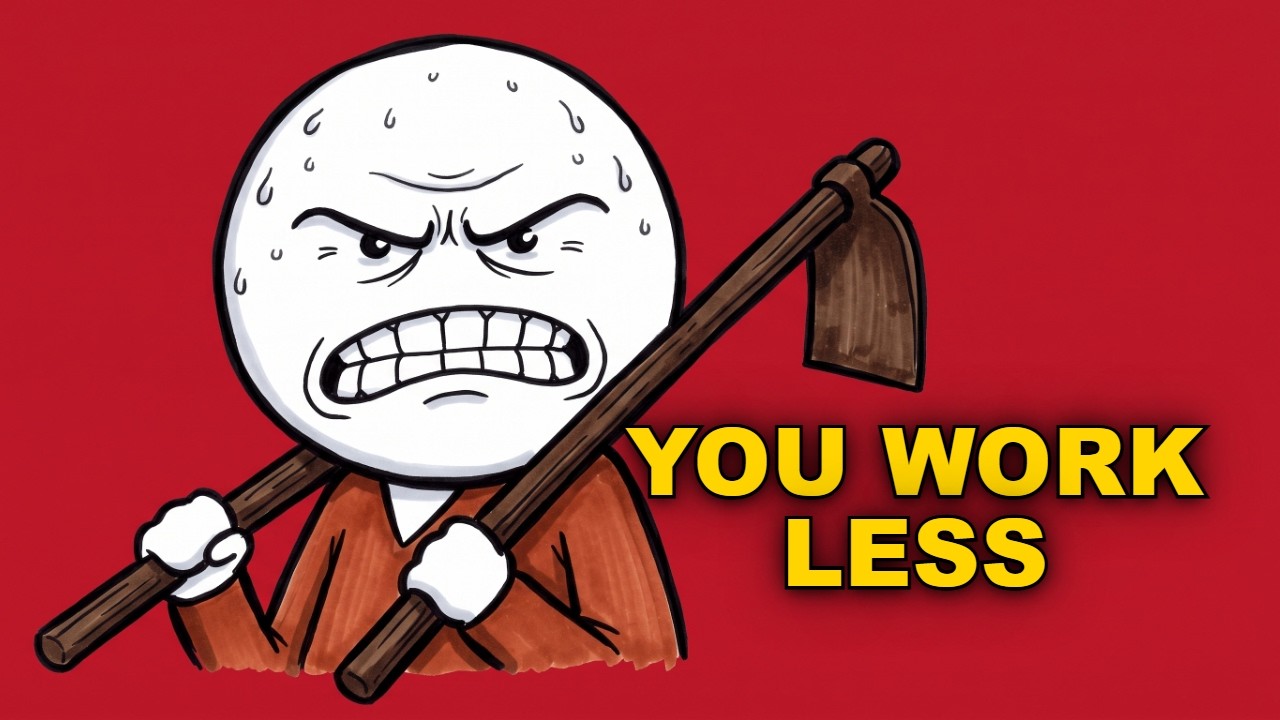
Your working year is about two thousand hours. A medieval English peasant's was longer. Not shorter.
Longer. The hundred and fifty days off that the internet keeps promising you is a game of telephone, and the defensible count puts him nearer two and a half
to three thousand hours. And yet the wage index says something stranger. On the standard measure, that overworked man's day bought more than a Victorian
labourer's did, four hundred years later. And that is what pulls me into this one. The man inside that number is not a different species from you. He is you, running the same life on far worse odds.
So hold him in your head for a second. He sleeps in a room with no chimney. Sugar is an import he will probably never taste. And he has fewer cavities in his mouth than you do.
Which leaves one question, and this whole video is walking toward it. How does a smoke-stained farm worker in a one-room house end up better off than a Victorian?
And what took it away again? Start with the hundred and fifty, because it is a real chain and you can walk down every link of it. The link you have seen is a book from
nineteen ninety-one, called The Overworked American. It cites an early working paper by an economist named Gregory Clark.
Clark abandoned that estimate. His later work points somewhere near three hundred days.
Go one link further down, to the nineteen thirty-five study underneath the book. Its author had concluded that the normal medieval working year was three hundred and eight days.
The figure that reached your feed is the near-opposite of the figure at the bottom of the pile.
Be fair to the other side, though. Jane Humphries and Jacob Weisdorf have published work supporting figures near a hundred and fifty for certain decades, and a great deal
of the fight is definitional. What counts as work. Whose work. Which season. But the arithmetic you can do at a kitchen
table goes like this. Take a year. Take out every Sunday. Take out roughly forty-five church feast days, when agricultural work stopped by
custom and by church law. You are left with about two hundred and seventy days on which a man can be sent to a field. At something like ten hours each.
And that is the generous version, because it counts him and not her. Nobody was tallying the brewing, the dairy, the poultry, the children, and the field work women did alongside all of it.
Two hundred and seventy is a man's number. There is a Latin teaching text written in England around the year ten hundred. A schoolroom dialogue, not a diary.
In it, a boy plays a ploughman and describes his day. He goes out at daybreak to yoke the oxen. No winter is so hard that he
dares hide at home, for fear of his lord. Every day he must plough a full acre or more. And he has a boy driving the oxen with a goad, who
is now hoarse from the cold and the shouting. That is a language exercise. But the goad, the cold and the acre are real.
So that is the year. Now the day. And the day starts in smoke.
Most peasant houses had no chimney. The fire sat in the middle of an open hall with no floor above it, and the smoke found its way out through a gap in the roof.
Archaeologists still identify these buildings today by the soot and tar baked into the surviving timbers. Surviving. That is the strange bit.
The frame was often cruck-built: pairs of curved timbers sweeping from the ground to the roof peak in one arch. More than three thousand of them are on record
in England, across a three-hundred-year run. A typical house was three bays. An open hall, a service room, and a sleeping chamber with a loft you reached by a
ladder. In the west and the north, the livestock lived under the same roof, penned at the far end from the family. That was regional, not universal. And these places were built to last.
The oldest house still lived in today that probably belonged to a peasant was made from trees felled in twelve sixty-two. Somebody in England watched television in it last night.
In the middle of the hall sat the pot. Not bread alone. Pottage: a thick grain-and-vegetable stew boiled all day.
In twenty nineteen, chemists at Bristol tested the residue soaked into pottery from a Northamptonshire village and found what was actually in it.
Beef and mutton, cabbage and leek, and soft fresh cheeses. The first direct chemical evidence of a peasant dinner.
The bread was usually not white. It was rye, barley, oats, or maslin, a wheat-and-rye mix, chosen by your soil and your
money. And the drink was ale, which was food. Low in alcohol, dense in calories, brewed constantly in small batches at
home because it went sour in days. Which brings us to the line everyone repeats. They drank ale because the water would kill you.
They drank water. Constantly. London began building the Great Conduit in twelve forty-five: a lead-and-wood pipe about ninety
millimetres across, packed in clay, carrying spring water three miles to Cheapside. That is piped municipal water six hundred years before the Victorians
took credit for it. And in that same schoolroom dialogue, the boy is asked what he drinks. Ale if I have any, he says. Or water if I have no ale. A preference.
Not a fear. Most of that ale was brewed and sold by women, out of their own front rooms, which is literally where the word ale-house comes from.
In one Northamptonshire village, thirty-eight women ran the entire commercial trade with almost no male competition. The manor appointed an
ale-conner to taste the batches and certify them fit to sell, and the pots had to carry an official seal against short measure.
Then the light goes. Curfew is not a modern word. It is Old French. Cuevrefeu. Cover the fire.
A bell rang, usually around eight or nine, and it was an instruction. Bank the open hearth. Go to bed. Because one unattended fire in
a street of timber and thatch could take the whole street. So the fire goes down. And the only light in the house goes down with it.
Now picture the room. The family sleeping in the spaces flanking the dead hearth. In some regions, animals breathing at the far end. Children in a loft up a ladder.
Nobody more than a few feet from anybody else, in a building with no interior doors worth the name. There is no privacy in this life at all. Not for a marriage, not for an argument, not for dying.
And the dark was when things happened. In London's coroners' rolls, more than three quarters of recorded killings fell between evening prayers and the hours after curfew. Sunday was the deadliest day of the week.
Now, you have probably heard what supposedly happened next inside that room. That they slept twice. A first sleep, then an hour awake in the dark, then
a second sleep. I have to slow down here, because I just took one viral claim apart for you and this one does not come apart the same way.
The hundred and fifty days had a bottom to it. You could climb down to the source and check. This one is two serious historians reading the same shelf of evidence and disagreeing, and I genuinely cannot tell you who is right.
So here is what each of them is holding. Roger Ekirch has gathered, by his own count, upwards of two thousand references to a first and a second sleep. Novels, letters, poems, court records, spread across centuries.
He describes people going to bed around nine or ten, waking near midnight, lying awake for half an hour or an hour, then sleeping again until dawn.
They prayed. They talked quietly to whoever was beside them. They turned over the dream they had just come out of. He can point to eighteen or more medical texts that prescribe things to do in that gap.
Against that: Niall Boyce went back through the early printed English books and searched for the phrase himself. Only five texts name both a first and
a second sleep. And first sleep, he shows, can mean at least five different things. One of them is simply your shift on a military watch.
Two more problems. Ekirch's pile is literary and legal, not medical measurement of anyone actually asleep, and most of it is early modern,
from after our period ends. For medieval England specifically, the attestation is thin. Chaucer has a character who is allowed to bed down early, sleeps her
first sleep, and wakes. And the science is one experiment from nineteen ninety-two. Sixteen people, fifteen of them men, in a windowless room with a fourteen-hour night imposed on them.
Their sleep divided into two blocks. Nobody in medieval England lived in a windowless room with a fourteen-hour night and no candle. Meanwhile researchers tracked
ninety-four adults across more than a thousand nights in three societies living without electric light. Those people rarely woke for long at all.
One of the researchers suggested the two-sleep pattern, where it existed, might be what a long northern winter does to a body handed more darkness than it needs.
Ekirch answered all of that in twenty twenty-four, and it was not a retreat. He argues his critic read selectively, and he clarifies that predominant never
meant everybody. So the honest end to this section is that there isn't one. By some accounts, some people in that room slept twice. How many, and whether it was ordinary, is an argument still running between
people who have read far more of it than I have. What we can date precisely is the other broken night, the one in the monastery down the road.
Benedictine monks went to bed just after six in winter, rose at two or three in the morning, and walked into a cold church to sing.
In winter they often did not go back at all, and used the dark hours for mending and small tasks. That is a documented medieval night cut in half.
It is also a rule of religious life, not evidence about the family asleep in the hall.
And if you wake at three in the morning yourself, I am not going to tell you it is a medieval ghost. Nobody can honestly tell you that yet.
The night is the hour we know least about. So let us go to the thing they
recorded obsessively: how people died. Start with the number everyone thinks they know. Nobody died at thirty. Life expectancy at
birth sat somewhere in the mid-twenties to early thirties, but that is an average dragged down by dead babies. Roughly a quarter to a third of children, by most
estimates, never reached adulthood. Survive that, and you could reasonably expect your fifties, your sixties, or beyond. Where you lived mattered more
than when. In a higher-status town cemetery in York, about half of those buried had died by forty. In the village of Wharram Percy, it was about
two thirds. Childbirth was dangerous, but it was not the mass killer of legend. The medieval estimates run no higher than around one birth in eighty, and
they come from a small sample of aristocratic women with better food and better care, so a peasant woman's risk was probably worse and cannot
really be measured. Still, only about one in ten deaths of married women of childbearing age was down to childbirth.
The vast majority survived. They were not children when they married, either. In England, women typically married in their middle twenties, with
a small age gap between husband and wife, after years spent living and working in somebody else's household, saving for a home of their own.
Violence, though, is where the numbers get loud. In late-medieval Oxford, the homicide rate ran at roughly sixty to seventy-five per hundred thousand people. Around fifty times a modern English city.
But that is Oxford, and Oxford was a freak. It ran four to five times higher than London or York, because it was a town of
about seven thousand people containing fifteen hundred students, and roughly three quarters of the identified killers were those students.
Teenagers with knives and no supervision. In London the coroners recorded the mechanics with terrible precision. Daggers and swords in
about two thirds of killings. Quarterstaves in a fifth. Two thirds of them in the street or the market. Ninety-two percent of killers were men. And here is the detail that tells you what century
you are in. More than one in six victims lingered a week or more before dying, of infection or blood loss. The jury measured the wounds.
One of them described a mortal wound on the crown of a man's head. Six inches long, and in depth reaching to the brain.
That is not a murder rate problem. That is a medicine problem.
Nature could do it wholesale, too. In thirteen fifteen, freak rain wrecked the harvest, grain prices roughly doubled between spring
and midsummer, and a cattle plague followed that gutted the herds. In the worst-hit areas, roughly a tenth of people died.
So this was a life you could lose quickly. Which makes what they spent
it doing genuinely funny. Because the unfree peasant, the villein, was not a slave. He had security of tenure. Protection against eviction. A reasonable expectation that his children would inherit his land.
He sued his neighbours constantly in the manor court, which borrowed its procedure from the royal courts, used juries, and kept written rolls as evidence.
By the late thirteenth century there was a busy market in unfree land, bought and sold through that court, thousands of transfers on some manors.
What made him unfree was the menu of fees. When his father died, the lord took the family's best animal before the son could inherit.
To marry a daughter off he bought a licence, and on one Suffolk manor that ran to about two shillings, more if you skipped it and got caught.
To live somewhere other than the manor, he paid an annual head-tax. Freedom of movement was something you rented by the year. And no, the
lord did not have a right to your wedding night. No contemporary law or court record establishes it in medieval England, and historians treat it as a later legend. The real thing underneath it was money, not sex.
What he did instead was break the rules constantly. English authorities banned football at least thirty-one separate times.
The first was thirteen fourteen, in the City of London, on pain of imprisonment, complaining about great uproar in the city arising from the striking of great foot-balls in the fields. That proclamation is the first time the word foot-ball appears
in English. The game used an inflated pig's bladder. No referee. No boundaries. No limit on players. It ran about four hours between landmarks at opposite ends of a town.
In the thirteen sixtys, Edward III ordered his sheriffs to prohibit stone throwing, handball, football, hockey, coursing and cock-fighting, and every other idle game, so that men would practise
archery instead. He was fighting France, and he thought English archery had been almost entirely abandoned. Compulsory leisure. That is a king legislating against a nation's hobby thirty-one times.
The same decade, Parliament passed a law fixing what each rank could wear and eat. Servants of lords capped at cheap cloth, no silk, no gold, no silver. Craftsmen allowed a little more, but no embroidered silks, no
precious stones. You do not write a law about a servant's coat unless servants have started buying better coats. And that is the doorway back to the number
we opened with. If you were here for the plague episode, you already know the first half. Fewer people, the same fields, and labour suddenly worth whatever the survivors said it was worth. The wage laws and the rising that followed are that story,
not this one. This one is what happened a century later. Because wages did not jump the moment the plague passed.
They fell through the thirteen fortys and kept falling into the thirteen sixtys, as grain prices swallowed every raise. Recovery only arrived in the later thirteen seventys, nearly thirty years after the pestilence.
But when it arrived, it compounded. England's population had gone from about four point eight million to under two million. Output fell as well, but by less than half, so income per head rose by something like forty percent.
Peasant holdings roughly doubled in size over the next century and a half. Survivors rebuilt in better timber, which is exactly why so many late-medieval peasant houses are still standing and so few earlier
ones are. And you can see it on the plate. Manorial accounts recorded what harvest workers were fed, in detail. In the thirteenth century they
got a great deal of bread, some cheese, and small quantities of ale, fish and meat. Two centuries later bread's share had shrunk, and a high proportion
of the meal was meat and ale. Barley and rye bread gave way to wheat. Bacon gave way to beef. That is what the wage peak actually looked like. Beef, on a farm labourer's harvest table, in the fourteen seventys.
Then the same arithmetic turned around and bit. Labour was expensive and land was cheap, so landlords found something that did not need people.
Sheep. Wharram Percy in Yorkshire had held about forty peasant houses at its height. Plague cut its recorded population from around sixty-seven to forty-five, and yet sixteen households were still living there half a century later.
What emptied it was not disease. In fifteen twenty-seven the landlord converted the last of its arable strips to pasture.
By the mid fifteen fortys the site carried one thousand two hundred and forty sheep and two shepherds. By the fifteen fiftys, nobody lived there at all.
A village does not always end with a catastrophe. Sometimes it ends with an accountant. And that is what the wage index is really telling you.
Not that the Middle Ages were kind, and not that they were a nightmare you could not survive. Just that there was a window, in a country of smoke-filled halls and banned football and knives after curfew, when an ordinary working life bought
more than it would buy again for four hundred years. It opened in fourteen seventy-six. Nothing beat it until the eighteen eightys. They played football until kings banned
it thirty-one times. They dodged the fees. They complained about the work and got told off for it. Not a different species. Us, running the same life on far worse odds.
There is another one of these coming, built the same way, with nothing in it we could not source. It is a very long way from an English field.
Subscribe, and you will be here when it lands.
Enjoyed this? Subscribe on YouTube or binge the whole Great Empires series — a new episode every Thursday.