
8 History 'Facts' That Never Actually Happened
The short answer
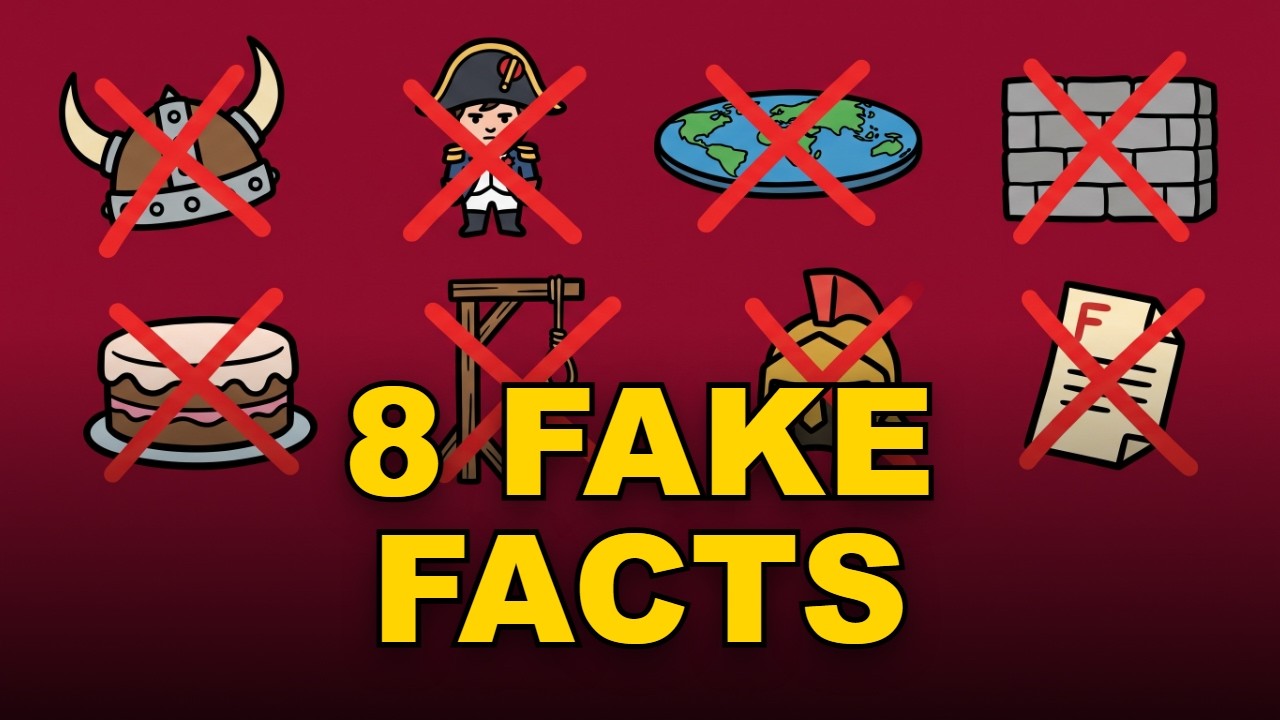
You were taught eight history "facts" in school that never actually happened. And every single one was invented by a real person, in a real year, with something to sell. From the Vikings' horned helmets to Einstein failing math, here is the true history behind the biggest lies you still believe.
The story
History myths debunked, one by one. Did Vikings really wear horned helmets? Was Napoleon actually short? Did medieval people believe the Earth was flat? Can you really see the Great Wall of China from space with the naked eye? Did Marie Antoinette say "let them eat cake"? Were the Salem witches burned at the stake? Did Roman gladiators always fight to the death? Did Einstein fail math? This is the real history behind eight famous historical lies and common misconceptions, and the exact people who invented each one. A tour through history's most successful misinformation, from ancient Rome to the medieval world: who invented each myth, in which century, and why the real history is stranger than the lie.
Chapters
- 0:00 The eight lies you were taught
- 0:47 1. The Vikings' horned helmets
- 1:59 2. Napoleon was short
- 3:25 3. The medieval flat Earth
- 4:23 4. Columbus and the round Earth
- 5:03 5. The Great Wall from space
- 6:09 6. 'Let them eat cake'
- 7:15 7. The Salem witches were burned
- 8:26 8a. Gladiators always fought to the death
- 9:27 8. Even Einstein failed math
- 10:25 Why these lies survive
Sources
Every claim in this episode is checked against these sources before publishing.
- No, Vikings Didn't Have Horns On Their Helmets — Discover Magazine
- Was Napoleon Short? — Britannica
- The Myth of the Flat Earth — Medievalists.net
- Columbus and the Flat Earth Myth — Stand to Reason
- Can You See the Great Wall of China From Space? — BBC Sky at Night
- Did Marie-Antoinette Really Say 'Let Them Eat Cake'? — Britannica
- How Were the Salem Witches Executed? — Live Science
- Did Gladiators Always Fight to the Death? — UNRV Roman History
- Einstein Failing Math (Making the Grade) — TIME
Full transcript
Read the full narration (2,016 words)
Out of all the history facts rattling around in your head right now, how many are
just flat-out invented? Not exaggerated. Not fuzzy.
Made up. I found eight, and every one has a real culprit behind it.
A costume designer. A cartoonist. A novelist.
And the exact year they made it up. And these aren't fringe internet nonsense.
Every single one is a fact you were handed in a classroom. By a teacher. From a textbook. You have believed some of
these your entire life. And here is what actually gets me about all eight.
Not one of them was an honest mistake. Every single one was invented
by somebody who had something to sell. A ticket. A newspaper. A war. History, it turns out, is mostly
just whoever told the best story. So let's start with the
one you are already picturing. A Viking. In your head, he is roaring on the prow of a longship, two enormous horns catching the light. It's terrifying. It's iconic. It's completely made up. Here's the tell. Dig up a Viking warrior's grave, and you will never find
a horned helmet. Not one has ever been excavated. The best real Viking helmet we have, the Gjermundbu helmet from Norway, is a plain round iron cap with a little bar to guard the eyes. No horns anywhere. And think about it for a second.
Horns on a battle helmet are a handle. They're something for an axe to catch. In a real fight they'd get you killed. So where did the horns come from?
A stage. In eighteen seventy-six, a German costume designer named Carl Emil Doepler dressed the Norse characters for Richard Wagner's opera, the Ring cycle, at Bayreuth. He gave the villains horns and the heroes wings, just to make them dramatic under the stage lights.
That's it. Every horned Viking you've ever seen, every Halloween costume, every sports mascot, descends from one opera costume. But the next one fooled an entire branch of psychology. Because you also know that Napoleon was tiny. A furious little man, barely
over five feet, hand tucked in his coat, overcompensating for his height. We even named a syndrome after it. The Napoleon complex.
Small problem. Napoleon wasn't short. He stood about five foot six or seven, which was average or even a touch tall for a Frenchman of his day. So how did average become tiny?
Two mistakes stacked on top of each other. First, a measuring mix-up.
His height was recorded in old French units, five pieds two pouces.
But a French pouce was longer than an English inch. Read it naively
as "five foot two," and you've shrunk him by four inches. Second, and this is the fun part, the British hated him. Their cartoonists, above all a caricaturist named James Gillray, drew him over and over as a pocket-sized brat they nicknamed "Little Boney."
Fuming. Stamping. Doll-sized next to normal men. It was war propaganda, and it worked so well it outlived the war by two hundred years. Even his French nickname, "le petit caporal," the little corporal, was affectionate, not an insult about his height.
The whole Napoleon complex rests on a man who was, in fact, perfectly
normal-sized. Now hold that idea, a lie that got taught as psychology,
because the next one got taught as history itself. You were told that in the Middle Ages, everyone thought the Earth was flat. That people cowered, sure that ships would sail off the edge, until brave
modern thinkers set them straight. It's a great story. It never happened. Educated medieval Europeans knew perfectly well the Earth was a sphere. The Venerable Bede wrote it down in the seventh century. Roger Bacon and Thomas Aquinas both described a round Earth in the thirteenth.
The proof is literally in the royal regalia, that golden orb the king holds, a little globe, because everyone knew the world was a ball.
So where's the pancake-Earth story from? A novel.
In eighteen twenty-eight, the American writer Washington Irving published a fictionalised
life of Christopher Columbus, and he invented a dramatic scene of scholars insisting
the world was flat. He made it up. Later writers, pushing a story of science at war with religion, hardened that invention into schoolbook "fact."
One novelist's scene became something your teacher told you was real.
And the hero we pin that bravery on, Columbus, had it backwards too. He didn't sail west to prove the Earth was round.
Everyone already knew that it was, and had since ancient Greece. The Greek scholar Eratosthenes measured the whole planet more than seventeen hundred years before
Columbus was born. The real argument was about distance, and on that, Columbus was flatly wrong. He picked a too small size for the Earth and convinced himself Asia was a short hop west. The Spanish scholars did the math correctly and told him the ocean was far too wide to
cross. They were right. He should have starved at sea, and only lived because an entire continent nobody in Europe knew about happened to be sitting in the way.
Now look up, because the next lie went all the way into orbit. You've been told the Great Wall of China is the only human-made thing you can see from space with your naked eye. Some people even say you can spot it from the Moon.
It's in textbooks. It's on trivia cards. And it is false.
You cannot see the Great Wall from space with the naked eye. Not from the Moon, and not even from
low orbit. The wall is at most about nine meters wide, and it's built from stone and packed earth the same color as the ground it runs across, so from above it simply blends in. Astronauts from the Apollo missions all
the way to the space station have looked, and confirmed it. You cannot pick it out. And here's the tell that the whole thing is nonsense.
The claim is older than spaceflight itself. A clergyman named William Stukeley wrote that the wall would be visible from the Moon back in the seventeen
hundreds. Ripley's Believe It or Not printed the "visible from space"
version in nineteen thirty-two. That is decades before any human
being had ever left the planet to actually check. People were dead certain you could see it from space, before anyone had ever been to space to look.
Now for a line you've heard a hundred times. The peasants have no bread, and
a spoiled queen sneers, "Let them eat cake." Marie Antoinette. Symbol of everything rotten about the old regime. Except she almost certainly never
said it. The line was already in print before she was old enough to say anything.
The philosopher Jean-Jacques Rousseau wrote "let them eat brioche" in his Confessions around seventeen sixty-seven, and he attributed it to an
unnamed "great princess." Now do the arithmetic. In seventeen sixty-seven, Marie Antoinette was about nine years old.
And she wasn't even in France. She was a child in Austria, years away from ever becoming queen. The quote wasn't pinned on her until long after the Revolution, by some accounts more than fifty years after her death.
A nine-year-old girl playing in Vienna took the blame for a sentence a grown philosopher wrote about someone else entirely. And today politicians
still throw that line around as shorthand for out-of-touch elites, quoting a woman who never said it. Okay.
Here's the part that should genuinely disturb you. You know the Salem witches were
burned at the stake. The screaming, the flames, the tied-up figure engulfed
in orange fire. You've seen it in every movie, every Halloween decoration.
Here is the truth, and it's worse. Nobody was burned at Salem.
Not one person. In sixteen ninety-two, nineteen convicted people were hanged. Taken to a ledge on a hill, and hanged from a plain wooden gallows.
And then there's Giles Corey. An eighty-year-old man who refused to enter a plea. So they laid him on the ground, put a board on his chest, and piled on stones. Heavier and heavier stones. Over two days. They slowly crushed him to death.
No fire. Just weight. So why do we all picture flames?
Because Salem followed English law, and under English law witchcraft meant hanging.
Burning at the stake was a continental European punishment, and a Scottish one. The fire you imagine is real, but it belongs to a different country.
Hollywood and folklore simply glued the wrong ending onto the wrong place.
And the true story, an old man pressed flat under rocks, is somehow the part
we chose to forget. After that, let's ease off the horror, because
this next one is just money. You know Roman gladiators fought to the death. Every single match, a body dragged off the bloody sand, the crowd howling for
it. It's the whole image. And it's mostly false. Most gladiator bouts did
not end in a death. A beaten fighter was very often spared. And the reason is beautifully unromantic. It's cost. A gladiator was an expensive machine. Years of food, training, and medical care went into him, all paid for by his owner.
Kill him, and you've set fire to your own investment. By some accounts, only about one in ten fighters actually died in a given bout. A brave loser who thrilled the crowd was usually granted mercy and sent back to fight another day, because a live gladiator earns and a dead one costs.
Yes, it got bloodier over the centuries as the games grew more extravagant.
But the movie version, every fight to the death, every time, is Hollywood, not
history. The arena was less a slaughterhouse and more a very violent, very
expensive sport. Which leaves the last lie.
And it might be the most comforting one we tell. Even Einstein failed math. You've heard it. A teacher probably said it to you to make you feel better after a bad grade. If the greatest genius who ever lived flunked math, there's hope for all of us.
It's a lovely thought. It is also completely backwards.
Einstein never failed math. He crushed it. He sat at the top of his class, and by his own account he had mastered differential and integral calculus before he was fifteen. As a boy he taught himself geometry and algebra over a single summer, and even worked out his own proof of
the Pythagorean theorem for fun. So where's the "failure" from?
A cartoon. In nineteen thirty-five, Ripley's
Believe It or Not ran a column headlined "greatest living mathematician failed in mathematics." Someone showed the clipping to Einstein himself. He laughed, and he said, plainly, "I never failed in mathematics." The genius personally denied it, in his own words, and the myth outlived
him anyway. And that's the thread running through all eight.
Look at who actually built these lies. An opera costume designer.
A cartoonist selling wartime hate. A novelist inventing a scene.
A tabloid chasing a headline. Not liars, exactly.
Just people telling a better story. And a better story always beats a true one, because the
better story is the one that spreads. The horns look cooler.
The tiny tyrant is funnier. The flames are scarier.
The failing genius is kinder. So we keep them, in movies and operas and schoolbooks, and we hand them to the next kid as fact. And that is the part I can't get past. History isn't always a record of what actually happened. Half the time it
is just whoever told the best story, loud enough and early enough that the rest of us quietly
stopped checking. So here's my question for you. Out of all eight, which one did you actually believe? Be honest, drop it in the comments, and go read the reply under yours, because I promise you're not the only one.
And subscribe, because next time we're pulling apart another "fact" everyone
knows and nobody checked. The next lie is already halfway written.
Make sure it finds you before your history teacher does.
Enjoyed this? Subscribe on YouTube — a new episode every Thursday.