Is Halloween Really 2,000 Years Old?
The short answer
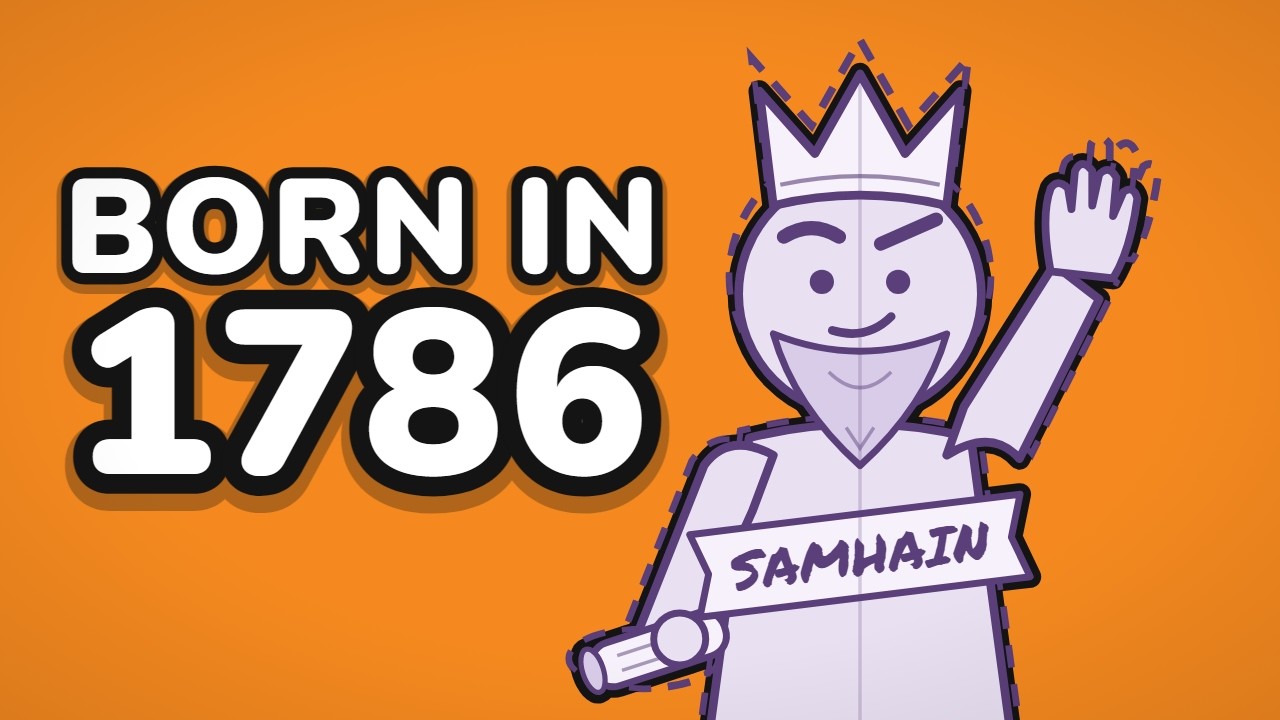
This Halloween, everything on your porch will be called 2,000 years old. But Halloween's famous Celtic god of the dead never existed: Samhain is still the ordinary Irish word for November, and the god was born on paper in 1786. We walk one night backwards, from your porch down through the centuries, to find what is really ancient about Halloween, and who made up the rest.
The story
Halloween history and the origins of Samhain: is Halloween really an ancient Celtic festival of the dead? We trace each piece of it: the oldest 'trick or treat' found in print (Ontario, 1917), pumpkin lanterns in American English (late 1820s) and Ireland's turnip lanterns, James Frazer's The Golden Bough and the 'Celtic New Year', Robert Burns's 1785 poem Halloween, Charles Vallancey's invented god Saman (1786), the druids' fire as told in a 17th-century history of Ireland, medieval soul cakes and All Souls' Day, and whether a pope moved All Saints to 1 November to replace Samhain. Then the real medieval Irish tale of Nera at Cruachan, the fairy mounds that open on Samhain night, and the Coligny calendar from Roman Gaul. Celtic history, ancient history and archaeology, Irish mythology, folklore and medieval history.
Chapters
Sources
Every claim in this episode is checked against these sources before publishing.
- Ronald Hutton, 'The Celtic New Year and Feast of the Dead', Folklore 135:1 (2024)
- The Adventures of Nera (Echtra Nerai), trans. Kuno Meyer
- Elva Johnston, 'A Season for Saints and the Supernatural', UCD (2017)
- Geoffrey Keating, Foras Feasa ar Éirinn, section 39 (CELT, University College Cork)
- James George Frazer, The Golden Bough: 'The Fire-Festivals of Europe'
- Robert Burns, 'Halloween' (Kilmarnock, 1786), Eighteenth-Century Poetry Archive
- Dictionary of National Biography, 'Vallancey, Charles'
- Helen Parish, 'The post-Reformation history of Hallowmass', University of Reading
- Pascal Tréguer, 'origin of the Hallowe'en phrase trick or treat', Word Histories
- America Magazine, Clodagh Doyle (National Museum of Ireland) on Irish Halloween traditions (2017)
- Online Etymology Dictionary, 'jack-o'-lantern'
- Scottish Poetry Library, 'Robert Burns'
- Spike Island Cork, 'Charles Vallancey'
- Catholic Encyclopedia (1907), 'All Souls' Day'
- New Catholic Encyclopedia, 'All Saints, Solemnity of'
- Library of Congress Research Guides, 'Halloween & Día de Muertos Resources'
Full transcript
Read the full narration (1,905 words)
This Halloween, everything on your porch will be called two thousand years old. But Halloween's famous Celtic god of the dead never existed. His name, Samhain, is still the ordinary Irish word for November. He was born on paper in seventeen eighty-six, in a book by an army surveyor who never mastered spoken Irish. He comes back every October with the rest of the story.
A festival of the dead. A Celtic New Year. Druids burning sacrifices. And a Church that stole the night. In one medieval Irish tale, on Samhain night, a warrior carries a hanged man through the dark, because the corpse is thirsty. So how much of your Halloween is actually ancient, and who made up the rest? For me the best part isn't the myth-busting.
It's that under all the inventions there really was an old night, and it's eerier than the one we were sold. To find out, we'll walk one night backwards. The last night of October, from your porch, down through the centuries, to the oldest word that might be its name. Start on the porch. A pumpkin with a candle inside. A knock at the door, and three words from a kid in a costume.
Those words have a birthday. On the first of November, nineteen seventeen, a newspaper in Ontario, Canada, printed this line. Tricks or treats, you could hear the gangs call out. It's the oldest trick or treat anyone has found in print. American papers caught on by the early nineteen-thirties. So as far as anyone can show, the words at your door are Canadian, and
just over a century old. The pumpkin is a little older. Carved pumpkin lanterns turn up in American English by the late eighteen-twenties. But in Ireland, the lantern was a turnip, and sometimes a big potato. The National Museum of Ireland keeps a plaster cast of one, a turnip lantern from Donegal, given by a schoolteacher. A hollowed root, made to carry a light through the dark. Lanterns like it were being carved in Donegal
around nineteen hundred. So the props are young. But the big idea underneath them, a festival of the dead, a Celtic New Year, sounds ancient. And while Donegal was carving turnips, two scholars were making that idea famous. The first was James Frazer, in Cambridge. He never did fieldwork. He sat down at his desk at eight every morning and often worked late into the night, twelve hours a day, often
fifteen, copying passages into his notebooks. His book, The Golden Bough, grew to twelve volumes. In it, Halloween seems to have been of old the time of year when the souls of the departed were supposed to revisit their old homes, in order to warm themselves by the fire. Seems. Frazer's pages are full of words like that. Perhaps. Would seem. He wrote that the Celts would seem to have dated
the beginning of their year from Halloween. The second scholar was Oxford's first Professor of Celtic. By nineteen-oh-one, he was arguing that Halloween began the Celtic year. His evidence wasn't ancient records. It was recent folk custom from the Isle of Man and Wales. Historian Ronald Hutton traces the modern belief to these two men, though the New Year idea had older roots. Frazer was almost blind by the end. When he died in Cambridge, his
wife followed him a few hours later. So what was Halloween before the scholars got to it? A Scottish farmer put it into verse, and his Halloween wasn't about the dead at all. Robert Burns wrote his poem Halloween in seventeen eighty-five, in between the back-breaking work of a string of small farms. It's a night of love charms. Young people pull kale stalks blindfolded. Two nuts go into the fire, each named for a sweetheart.
Someone eats an apple in front of a mirror by candlelight, hoping to glimpse a future husband or wife. In his footnotes, witches, devils and other mischief-making beings are all abroad on their midnight errands, and the fairies hold a grand anniversary. No festival of the dead. No New Year. No trick or treat. It's mostly about who you're going to marry. The poem came out the next summer
in his first book, just six hundred and twelve copies. Ten years later, Burns was dying, and his last poem was a song for the woman who nursed him. The year the poem came out, in Ireland, another man was writing about this night. Charles Vallancey was a mapmaker first. His detailed map of Gibraltar is still in the British Library. He had come to Ireland for an army survey,
made it his home, and married four times. He had never gained real knowledge of the old Irish manuscripts. Yet that year, he described a Celtic judge of souls called Saman. A feast day had become a god. A word for November had become a judge of the dead. More than a century later, the Dictionary of National Biography judged his books in one line. Their facts are never trustworthy, and
their theories are invariably extravagant. He was buried in Saint Peter's churchyard in Dublin. His god is repeated every October. Vallancey gave Samhain a god. He didn't give it the druids. They were already burning victims in a history of Ireland written in the sixteen-hundreds. An Irish priest wrote that history. By his account, on the eve of Samhain, the druids of Ireland were brought together at a fire to offer sacrifice to all
the gods, and at that fire they used to burn their victims. According to historian Ronald Hutton, nobody knows what his sources were. So where, in the real records, are the dead on this night? In church. Shakespeare could mock a lovesick man for speaking puling, like a beggar at Hallowmas, because begging door to door at that season was a familiar sight. Earlier that century, England's monarchs
had ordered the old festival suppressed, bells for the dead included. People rang the bells anyway. Two centuries before Shakespeare, around thirteen eighty, an English preacher was already calling it an old custom. In olden time, he wrote, good men and women would this day buy bread and deal it for the souls that they loved, hoping with each loaf to get a soul out of purgatory. That bread became the soul cake, baked
for poorer neighbours. In parts of England, children were still trading soul cakes for prayers in the eighteen-hundreds. The Church's day for the dead came from the abbey of Cluny. Around the year ten thirty, its abbot, Odilo, ordered his monasteries to remember all the faithful dead every year, on the second of November. In time, the whole Church took up his day. We call it All Souls.
In a famine around then, Odilo sold or melted down much of the church's precious plate so the poor could eat. He died in his late eighties, at New Year, visiting one of his priories. So there is a documented festival of the dead at this season. It's Christian. Did the Church steal the rest of the night, too? The story says a pope moved All Saints to the first of November to swallow Samhain. The calendar doesn't
cooperate. Rome's first feast for all the martyrs, when a pope dedicated the Pantheon, fell in May. The first of November turns up for certain in the decades around eight hundred, in two places at once. An English-trained scholar praised an archbishop for keeping it. And an Irish calendar of saints names the great crowd of saints on Samhain, November the first. Why that date? Scholars still argue.
One looks to Ireland, another to England. It may even have been a Christian answer to the old feast. But nobody has found a pope choosing that date to bury Samhain. So what was Samhain, before the saints? Its stories were written down by Christian monks. One of them begins at a royal fort, the day after two men were hanged. It's Samhain night at Cruachan. The king makes a dare. His own gold-hilted sword, to anyone who will go out in the dark to the hanged
men. A warrior named Nera takes it. Out there in the dark, one of the hanged men speaks. I was very thirsty when I was hanged. He wants a drink. So Nera lifts the dead man onto his neck, and carries him through the night to find one. What Nera sees next is the royal fort, burnt. It's a vision of what the host of the fairy mound means to do. And Nera goes inside the mound itself, where he learns the rule of this night.
The fairy mounds of Ireland are always opened about Halloween. When he comes back out, he carries proof of where he's been. Summer plants, in November. Wild garlic. Primrose. Golden fern. Even here, the English translation says Halloween. The Irish says Samhain. The translator wrote the modern name into the old tale. That is the old night. Not a veil wearing thin, which is modern wording.
A door, standing open. In the tales, Samhain brings assemblies, feasts and doomed kings. Magical lovers are wooed. People turn into swans. Mortals walk into the immortal world. This world and the other one bleed into each other. There's even a dead man who talks. But there's no god of the dead, and no New Year. Everything that sounds most ancient came later. The druids' fire, from the sixteen-hundreds. The god, from Vallancey.
The New Year and the feast of the dead, made famous around nineteen hundred. And the pope who stole Samhain has never been found. To be fair to Frazer, his dead coming home to the fire isn't pure fantasy. Later Irish families did set out food, or a place, to welcome their own dead on this night. But that's folk custom, not a pagan rite anyone can show, and it sits right beside All Souls. So what, if anything, reaches
back two thousand years? One object. The Coligny calendar, made of bronze in Roman Gaul around the second century. It names a month, Samon, and marks three nights of Samon. No gods. No dead. No rites. Scholars can't even agree the month fell in autumn. It may be the same name as Samhain. It may not. So is Halloween two thousand years old?
Its oldest name might be, just about. The night of open mounds is at least as old as the monks who wrote it down. Everything else arrived on the way. Bread for the souls. Love charms. A turnip with a light inside. Three words from Canada. And today, the Library of Congress research guide still says Halloween began in a Celtic festival of the dead called Samhain.
Halloween is old. Just not in the way we were told. Every century that passed through this night left something behind, and we haven't stopped. Strip away the inventions, and there's still a night when the mounds stand open. That's the Halloween I'm keeping. Everything on your porch this Halloween will still be called two thousand years old. But there never was a god of the dead named Samhain. There was a month, and a feast.
An army surveyor gave it a god, and the rest of us kept him. More legends are waiting on the doorstep. Subscribe, and we'll open the door on the next one.
Enjoyed this? Subscribe on YouTube or binge the whole Great Empires series — a new episode every Thursday.