
The Bronze Age Collapse: Who Killed Every Empire at Once?
The short answer
Three thousand years ago, nearly every superpower on Earth collapsed at almost the same moment — and no one has ever been able to say who, or what, killed them. This is the Bronze Age Collapse: the greatest cold case in ancient history.
The story
The Late Bronze Age Collapse explained: what caused the Bronze Age Collapse, who the Sea Peoples really were, and how a connected world of empires — Egypt, the Hittites, Mycenaean Greece, Ugarit and Babylon — all fell in roughly fifty years around 1200 BC. We walk the whole cascade one suspect at a time: a mega-drought, famine and the desperate grain letters, the earthquake storm, the Sea Peoples raids, the burning of Ugarit and Hattusa, systems collapse, and a Greek Dark Age so complete that people forgot how to write for three hundred years. This is ancient military and economic history in one cascade: invasions, famine, earthquakes and collapsing trade across the first connected civilization of the Mediterranean world.
Chapters
- 0:00 The Greatest Cold Case in History
- 1:09 The Golden Web — a world on one thread
- 2:16 The Sky Turns — the mega-drought
- 2:49 Hunger and the 450-Ton Plea
- 4:00 When the Ground Betrayed Them
- 4:54 Who Were the Sea Peoples?
- 6:08 The Dominoes Fall — Ugarit and Hattusa
- 8:10 The Silence — a world forgets how to write
Sources
Every claim in this episode is checked against these sources before publishing.
- Eric H. Cline, '1177 B.C.: The Year Civilization Collapsed' (Princeton University Press)
- The Mysterious Bronze Age Collapse — interview with Eric Cline (World History Encyclopedia)
- Kaniewski et al., 'Environmental Roots of the Late Bronze Age Crisis' (PLOS ONE)
- The Last Days of Hattusa (Biblical Archaeology Society)
- Sea People (Encyclopaedia Britannica)
- Greek Dark Age (World History Encyclopedia)
- The Uluburun Shipwreck (The Archaeologist)
Full transcript
Read the full narration (1,984 words)
Every superpower on Earth died at the same time. And no one has ever been able to say who killed them.
In a single lifetime, the mightiest kingdoms of the ancient world all fell at once. Not one of them. All of them.
Mycenaean Greece. The mighty Hittite Empire. The rich trading cities of the coast. Wiped off the map inside about fifty
years. And then something happened that still doesn't feel real. The few who survived were so broken they forgot how to write. A whole civilization lost its script. And it stayed that way for roughly
three hundred years. The thing I keep circling is that no single blow did this. It was how each disaster handed the next one a
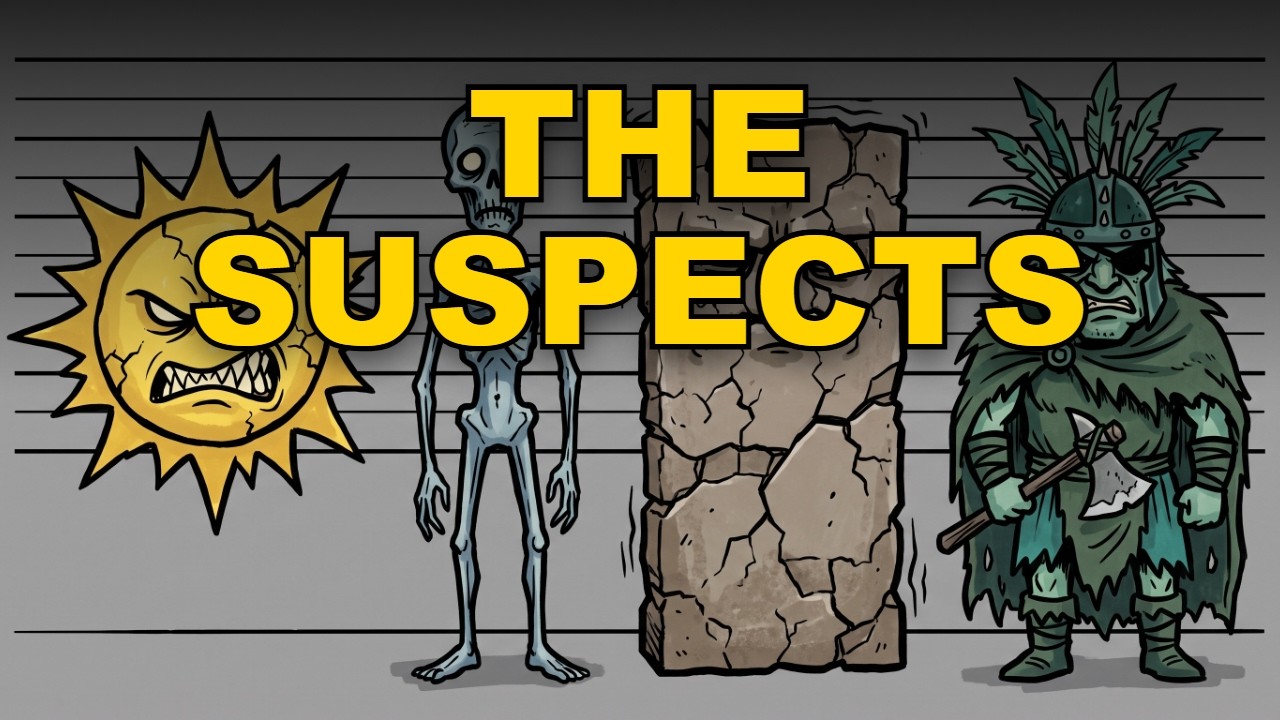
loaded gun. So here is the question that has haunted historians for thirty centuries. What force is strong enough to kill every superpower on the planet at once? Because there is a lineup of suspects.
And there is no confession. This is the greatest cold case in human history, and I am going to walk you through the suspects one by one. Fair warning. It gets worse with every single one. Start with how strong this
world was. That is the first trap. This was not a collection of isolated tribes. This was a globalized world. Egypt, the Hittites, the Greeks, Babylon, Cyprus, the kings of the coast, all linked together.
They wrote each other letters. They married each other's daughters. They shipped copper and tin and gold across the entire known sea.
We even found the proof at the bottom of the ocean. A single wooden ship that sank off the coast of Turkey. Divers pulled up ten tons of copper. A ton of tin.
Treasure from Egypt, from the Levant, from Mesopotamia, from Greece. One boat carrying a whole world in its belly. And here is the fuse nobody
sees at first. Bronze is the metal that named this entire age. But bronze is an alloy. You need copper, and you need tin.
And the tin had to be carried from far, far away, across the whole trade network. Which means the strongest empires on Earth were all standing on the same thread. Cut that thread, and every one
of them falls together. They were not just connected. They were fragile. Now cut the first thread.
The sky turns against them. Around twelve hundred BC, a drought settles over the entire eastern Mediterranean. Not a bad summer. A mega-drought. We can read it in the pollen buried in ancient lake beds.
By some estimates it lasted a hundred and fifty years. In some places, closer to three hundred. The rivers shrink. The Nile floods weaken.
The rain simply stops coming. And a world of millions of people is suddenly staring at empty fields. But drought is only the first suspect. Because a dry field leads to something far more frightening.
People start to starve. This is where the letters get desperate. And here is a detail I still can't shake. When the famine bit, the great kings did not go to war over the last of the grain. They shipped it to each other.
Egypt sent grain north to the Hittites, and a pharaoh wrote that it was sent to keep the land of Hatti alive. Keeping your rival breathing, because if he falls,
you might be next. Then it gets darker. A Hittite king writes to a coastal city with a demand that reads like a scream. He needs a ship. He needs a crew. He needs roughly four hundred and fifty tons of grain. And he calls it, in his own words, a matter of life or death.
Read that again. The empire that once terrified Egypt is now begging a smaller kingdom for food. And here is the cruel part.
Their whole economy ran through the palace. Everything flowed in, everything flowed out, all controlled from the top. It was efficient. It was rich. And it had absolutely no backup plan.
When the center couldn't feed people, there was nothing underneath to catch them. So now you have drought. And famine.
Two suspects in the room. You would think that is enough to explain a collapse. It isn't. Because the ground itself is about to betray them.
Some scientists believe the region was hit by what they call an earthquake storm. Not one quake. A rapid-fire sequence of them, rolling across the land over about fifty years, from Greece all the way to Anatolia.
You can still see the damage in the stones at Mycenae. At Tiryns. Great walls cracked and toppled.
And watch what the survivors do next. They start building differently. Massive walls of enormous boulders. Heavy fortified gates. These people were suddenly afraid. Not just of the earth shaking.
Of what might be coming for them. Now, I have to be honest with you here, the way the historians are honest. The earthquake storm is a theory, and a debated one. Some scholars doubt a quake brought Mycenae down.
That is the strange thing about this whole mystery. Every suspect has an alibi. No single one of them can be pinned with the crime. Which brings us to
the suspect everyone loves to blame. The ships appear on the horizon. Out of the sea come raiders. The Egyptians called them, roughly, the peoples of the sea. And for a long time, this was the answer.
A mysterious horde of invaders who burned the Bronze Age to the ground. Case closed. But wait. Who were they, actually?
Nobody knows for sure. That is the honest, haunting truth. Line them up like a suspect row. The Peleset. The Sherden. The Shekelesh. The Denyen. Strange names carved on Egyptian stone, and next to each one, a shrug.
We are not even sure which came from Sicily, which from the islands of Greece, which from somewhere we have never even found. Their true home, their real identity, whether they were one people at all, remains a genuine mystery to this day.
And here is the part almost nobody tells you about the Sea Peoples. They may not have been an invading army so much as a fleeing one.
Think about it. A drought. A famine. Whole populations with nowhere left to farm, piling into boats, moving along the coast in search of anywhere that still had food. They weren't only causing the collapse.
They were running from it. Refugees and raiders at the same time. The victim and the weapon. Now watch the dominoes actually fall.
We have the last words of a dying city. A coastal kingdom called Ugarit. Its final letters were dug out of the ruins, and they are chilling.
The king writes that the enemy's ships have already come. That his cities are burned. That they have done terrible things in his land. Then the letters stop. Ugarit burned to the ground and was never lived in again.
And here is the ghost detail. Those clay tablets survived for one reason only. The fire that destroyed the city baked the clay hard as stone. We can read his last cry for help today because the disaster that killed him preserved it. His scream, fossilized by the flames.
The Hittite capital falls next, and not the way you would expect. There was no glorious last stand at Hattusa. The diggers found something eerier.
The people had already left. The royal family, the scribes, the treasures, all gone before the end. They evacuated their own capital and walked away. And then the empty city was burned. A ghost town set on fire.
Only Egypt holds the line. A pharaoh named Ramesses the Third meets the Sea Peoples in a huge land-and-sea battle in the Nile Delta.
His temple walls scream that he won, that he killed enemies by the thousands. Maybe he did. The numbers are royal propaganda, so we take them with caution.
But even in winning, Egypt was gutted. It survived the storm and never fully stood tall again. And here is the clue that breaks
the easy answer for good. Kingdoms far from any coast fell too. Deep inland, the ancient dynasty that ruled Babylon toppled as well. Even Troy, the city of legend, burned in roughly this same dark window.
No fleet of raiders could have reached them all. Something bigger than any army was loose in the world. This is the moment historians call a systems collapse.
One severed trade route starves the next kingdom. That kingdom falls, and its collapse drags down the next. Cut one thread, and the whole web unravels, faster and faster, until there is almost nothing left to fall. And what is left is the sound
that gives this whole story its horror. Silence. The palaces are ash. The kings are gone. The trade ships stop sailing. And in Greece, the
writing simply ends. The script they used, called Linear B, vanishes completely. Because it only ever recorded the palace accounts, and when the palaces died, there was no reason left to write at all. Sit with that.
A literate world went dark. By some estimates, as many as nine out of ten small settlements in southern Greece were simply abandoned. The cities emptied. The population crashed.
And for roughly three hundred years, Greece could not read or write a single word. When writing finally returned, it was not even the same system.
It was a brand new alphabet, borrowed from elsewhere. The old script was gone forever. Every hero, every king, every song from before the dark, unwritten and unremembered. They didn't just lose a civilization.
They lost its memory of itself. So who did it? Who killed every superpower on Earth at once?
Here is the answer, and it is the reason this story genuinely frightens the people who study it. Nobody did. And everybody did. There is no single villain.
The drought weakened them, so the famine could bite. The famine drove the migrations, so the raiders came. The earthquakes shattered the cities that were already starving. The trade collapsed, so the kingdoms that depended on it fell in a row.
Each disaster made the next one deadlier. A perfect storm, with no one hand to blame. And that is the terror of it. A whole civilized world can die with no single killer to point at. Not conquered. Not cursed.
Just overwhelmed, all at once, by everything. And notice, it was not the whole planet that fell. It was the connected part. The web of palaces that all leaned on each other. We like to think we have outgrown
that danger. We are more connected than any Bronze Age king ever dreamed. So was the world that shipped its tin across the sea, right up until the thread snapped.
That is the warning I take from it. Collapse rarely arrives as one big thing. It comes as everything at once, a little too late to stop.
Remember how we started. A connected world, vanishing in a lifetime. A people who forgot how to write. Three thousand years later, we are
still reading the last letter of a doomed king, only because the fire that killed him saved his final words. That is the whole Bronze Age in one image. A scream, baked into clay, waiting in the dark for someone to finally hear it. Out of that silence, eventually,
new peoples rose. New tools. A new alphabet, the ancestor of the very letters on your screen right now. But that is a different story.
Next time, we crown a very different kind of power. One that would build its entire world around never being caught weak and starving like this again. We are going to Sparta.
Subscribe, and stay with me, because the empires that clawed their way out of these ashes are somehow even stranger than the world that burned.
Enjoyed this? Subscribe on YouTube or binge the whole Great Empires series — a new episode every Thursday.