
Julius Caesar Was Never Emperor. So Why Did 60 Senators Kill Him?
The short answer
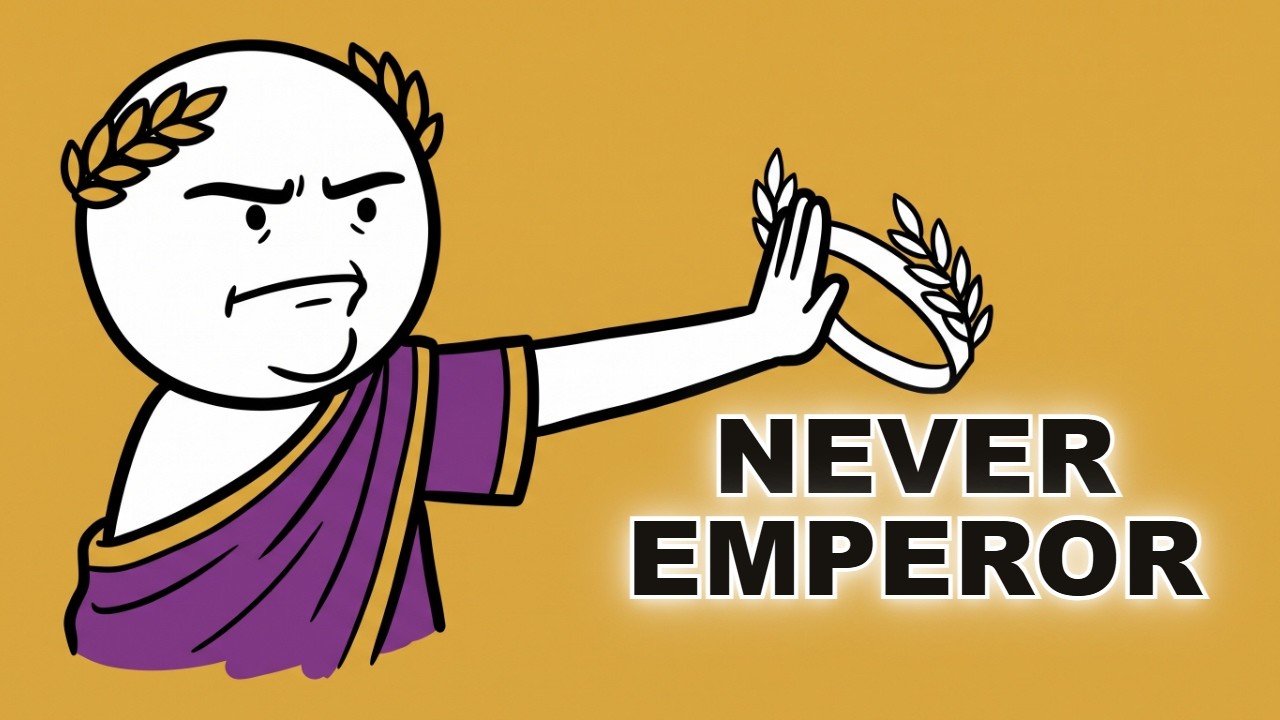
Julius Caesar was never emperor of Rome, yet more than sixty senators plotted to kill him and stabbed him twenty-three times. The sourced history of the man who built your calendar: the pirates, the debts, Gaul and Alesia, the Rubicon, the coin with his living face, the crown he refused, the Ides of March, and what the daggers actually saved.
The story
Julius Caesar explained: the ancient history and military history of the late Roman Republic, from Caesar's kidnapping by pirates and the debts Crassus guaranteed to the First Triumvirate with Pompey, the conquest of Gaul, the Rhine bridge, the siege of Alesia and Vercingetorix, crossing the Rubicon in 49 BC, the Battle of Pharsalus, Pompey's death in Egypt, Cleopatra and Caesarion, the Julian calendar reform of 46 BC, the CAESAR DICT PERPETVO denarius, the Lupercalia diadem, the assassination of Julius Caesar on the Ides of March 44 BC by Brutus and Cassius, the will that made Octavian his heir, the fates of the assassins, and how killing Caesar ended the Roman Republic and created the first Roman emperor, Augustus. Why Julius Caesar was never emperor, how many times was Caesar stabbed, did Caesar say Et tu Brute, and the civilization of ancient Rome told from Suetonius, Plutarch, Appian, Cassius Dio and Caesar's own commentaries.
Chapters
Sources
Every claim in this episode is checked against these sources before publishing.
- World History Encyclopedia — Julius Caesar
- World History Encyclopedia — The Assassination of Julius Caesar
- Livius.org — Gaius Julius Caesar (multi-part biography, Jona Lendering)
- Livius.org — Siege of Alesia (52 BCE)
- National Geographic — Inside the conspiracy to kill Julius Caesar
- Smithsonian Magazine — The hunt for Julius Caesar's assassins
- American Numismatic Society — RRC 480/15, the CAESAR DICT PERPETVO denarius (44 BC)
- Suetonius, Life of Julius Caesar (Loeb, LacusCurtius)
- Plutarch, Life of Caesar (LacusCurtius)
- Plutarch, Life of Brutus (LacusCurtius)
- Appian, Civil Wars 2.117 — the assassination (Perseus)
- Cassius Dio, Roman History 44 (LacusCurtius)
- Caesar, Gallic War 7 — Alesia (Perseus)
- Velleius Paterculus 2.87 — the last assassin (LacusCurtius)
- Folger Shakespeare Library — Julius Caesar, Act 3 scene 1 ('Et tu, Brute?')
- Tales of Times Forgotten — No, Julius Caesar was not born by cesarean section
- UC Berkeley Astronomy — History of calendars (46 BC, the Gregorian fix of 1582)
Full transcript
Read the full narration (2,089 words)
Julius Caesar built the calendar on your phone, right down to the leap day and the month of July. And he was never emperor of Rome.
Not for a single day. His office was dictator for life, and to more than
sixty senators that was close enough to a crown to kill him for it.
Twenty-three stab wounds, in the middle of a Senate meeting.
For a crown he had refused, again and again, in front of a cheering city. And I will be honest about what pulls me into this one.
I think the sixty were reading him correctly. Their mistake was not the diagnosis.
So why kill a man for a crown he kept refusing? Keep that question, because
weeks before the knives came out, the mint of Rome struck a silver coin with the face of a living man on it. Until then, that spot belonged to gods and the dead. By the end of this you will know exactly
why men who owed him their careers and their lives decided he had to die,
and what the killing actually saved. It was not the Republic.
His family claimed descent from the goddess Venus, and Caesar said so out loud at his own aunt's funeral. But divine blood does not impress a dictator.
When Caesar was a teenager, the dictator Sulla ruled Rome by death
list, and he ordered the boy to divorce his wife Cornelia.
Caesar said no. He lost his priesthood and hid with a price on his head, until
Sulla gave in, with a warning. In this Caesar, he said, there is
more than one Marius. A few years later, pirates seized him at sea and asked twenty talents. Plutarch says Caesar laughed at them and insisted he was worth fifty.
He spent nearly forty days as their prisoner, cheerfully promising to crucify them. They thought it was a joke. The ransom was paid.
Therefore Caesar raised ships, hunted them down, and crucified them.
He also had no money. By one account he owed
thirteen hundred talents before he had held a single post, and still staged games with
three hundred and twenty pairs of gladiators on credit. In Spain, aged about
thirty-three, he read about Alexander the Great and burst into tears.
At that age, Alexander had ruled half the world. In sixty-three BC
he ran for chief priest of Rome, Pontifex Maximus, and borrowed
so heavily that losing meant exile. Suetonius says that on election
morning, as his mother kissed him goodbye, he told her he would not come home except as pontifex. He came home as pontifex.
Two years later his creditors blocked the road out of Rome until Crassus, the richest man in the city, stood surety for eight hundred and thirty talents.
Seventeen tonnes of silver. Therefore, with Crassus's money and Pompey's soldiers,
he made a private pact that Livy called a conspiracy against the state by its
three leading citizens. As consul he steamrolled his colleague Bibulus
so completely that Bibulus stayed home, and Romans joked about the consulship
of Julius and Caesar. Then, Gaul, four legions, and the best part of
a decade to use them. The ancient writers claim he stormed eight hundred towns and
fought three million men in Gaul. Treat those numbers as advertising.
But the engineering is in his own field notes. Boats, he wrote, were
beneath the dignity of Rome, so his legions bridged the Rhine in ten days, marched over, raided, marched back, and tore it down.
The point was that he could. Then Alesia.
In fifty-two BC a chief called Vercingetorix united Gaul and shut himself
inside a hill town with, by Caesar's count, eighty thousand men. Caesar did not attack. He built a wall around the town, eleven miles of it. Then a second wall facing outward, fourteen miles, because a relief army was coming that Caesar numbered at nearly a quarter of a million.
A Roman army between two rings of its own timber, enemies inside and out, and the thud of picks for days. The relief army broke on the outer wall.
The town starved on the inner one. Plutarch tells the surrender like
theatre. Vercingetorix rode out in his finest armour, circled the seated Caesar once, stripped the armour off, and sat at his feet without a word. Caesar's own report is four words: Vercingetorix
is delivered up. The Senate looked at the walls and the money, forty million
sesterces a year in tribute from Gaul, and got frightened.
It ordered Caesar, and only Caesar, to give up his legions.
If you saw our Rome episode, you know he crossed the Rubicon.
Here is what that episode left out. The Rubicon was the legal edge of his province,
and a governor who led an army across it was, by definition, a rebel invading Italy.
He did it at night. And nobody agrees on what he said.
Suetonius has him say in Latin, the die is cast. Plutarch has him say it in Greek, let the die be cast, a line from
a comedy by Menander. He started a civil war with a quote from the theatre.
Eighteen months later, in Greece, Pompey's army outnumbered his roughly two to one, by Caesar's own tally, and Caesar destroyed it.
Pompey fled to Egypt and was stabbed to death as he stepped ashore.
When they showed Caesar the head, he turned away. But they handed him Pompey's seal ring, and Caesar wept over it. His rival, and
his son-in-law. In Alexandria a queen had herself tied inside a bed-sack, not a carpet, and carried past the guards into his rooms.
Her name was Cleopatra. Within a year she had a son the Alexandrians called Caesarion. Her story is its own story.
In Pontus he won a battle and reported it in three words: came, saw, conquered.
In Africa his oldest enemy, Cato, refused to be pardoned.
He read Plato, stabbed himself, and when a doctor stitched the wound, Cato tore the stitches open with his own hands. He came home to four triumphs on four days.
Vercingetorix, six years in a cell, was paraded through Rome and afterwards put
to death. And in the middle of the parades, Caesar rewrote time.
As chief priest he owned the calendar, and it had drifted months from the seasons.
So he stretched forty-six BC to about four hundred and forty-five days, a year
of fifteen months. Romans called it the year of confusion.
After it: three hundred and sixty-five days, a leap day every fourth year. A pope trimmed ten days off it in fifteen eighty-two, and that is the calendar
in your pocket. The Senate then renamed his birth month.
July. Now count what a king has. Dictator for ten years, then, in
February of forty-four BC, dictator for life.
Dictator perpetuo. A statue of him, set among the statues of Rome's
ancient kings. A raised couch in the theatre.
When the Senate came to him with new honours, he received them sitting down, without rising. He said the Republic was nothing, a name without body or form.
Then the coin. A silver denarius, his wreathed profile on one side, the legend CAESAR DICT PERPETVO around it. Until then, the face on Rome's money belonged to gods and dead heroes.
About that wreath: Suetonius says his baldness troubled him more than anything, so he combed his few hairs forward over the crown, and of all his honours the one he loved most was the right to wear a laurel wreath at all times.
The most powerful man alive, hiding a bald spot. When a crowd hailed him as king, he answered that his name was Caesar, not king. But at the Lupercalia that February,
Mark Antony ran up to the platform with a diadem wrapped in laurel and set it on his head. Caesar pushed it away. The crowd cheered. Antony tried again. Refused again, louder cheers.
Caesar sent the diadem to the temple of Jupiter and had his refusal written into
the public record. There is the answer. He refused the word king
while taking everything a king has. The office for life. The statue. The couch. The coin. The year itself.
To more than sixty men, by Suetonius's count, over eighty by another, the refusal was the proof. You do not need a crown when you already
own the calendar. And look at who they were. Brutus and Cassius,
both pardoned by Caesar after Pharsalus, both promoted to praetor by
him. Decimus Brutus and Trebonius, two of his own trusted
officers. Brutus's mother, Servilia, had been Caesar's mistress for
years; he once bought her a single pearl for six million sesterces.
Rome whispered that Brutus was Caesar's son. But the whisper was in the room.
A soothsayer had told him to beware the Ides of March.
His wife Calpurnia dreamed she was holding him, bleeding to death, in her arms,
and begged him to stay home. But Decimus Brutus came to the house in person and talked him out of it. On the way in he told the soothsayer the Ides had come.
Come, the seer answered, but not gone. The Senate met in the hall attached
to Pompey's theatre. Trebonius stopped Antony at the door and kept him
talking. Inside, a man named Cimber came forward with a petition,
and the rustle of cloth was the signal: he grabbed Caesar's toga and dragged it down from his shoulders. Casca struck first, near the neck, and
Caesar shouted in Latin, accursed Casca, what are you doing? Then the crush. The scrape of blade on blade, because so many
men pushed in that they wounded each other. Cassius cut his face. Brutus struck his thigh, and was cut in his own hand by a friend's dagger. Twenty-three wounds, by most accounts. According to Suetonius, a physician
later examined the body and found only one of them fatal, the second, in the
chest. Caesar pulled his toga up over his head so no one would see his face. He fell at the foot of Pompey's statue.
Et tu, Brute, is Shakespeare. Suetonius says Caesar
said nothing after the first blow, though some claimed he spoke to Brutus in Greek:
you too, child? Three slaves carried him home on a litter through the Forum, his hands hanging over the sides. He was in his fifty-sixth year.
Then the will was opened. Three-quarters of everything, by Suetonius's
account, went to an eighteen-year-old great-nephew called Gaius Octavius.
At the funeral Antony held up the toga, torn and stiff with blood.
The crowd built a pyre from benches, burned the body in the Forum, and went hunting
the killers. That summer a comet burned for seven nights, and Rome decided
it was his soul. The killers scattered.
Suetonius says hardly any of them outlived him three years, or died in bed.
Trebonius, the man at the door, went first: beheaded at Smyrna, his head kicked
along the pavement like a ball. Decimus Brutus was caught by a Gallic chief
and beheaded on Antony's orders. Cassius died at Philippi on his
own birthday, killed by his own freedman, Plutarch says with the same dagger
he had used on Caesar. Brutus fell on his sword.
The last of them, Cassius of Parma, ran for fourteen years and was beheaded in Athens.
And the boy from the will beat Antony, had Caesarion killed, and in twenty-seven BC
took the name Augustus. The first emperor.
Every emperor after him took Caesar as a title, and the name walked into German
as Kaiser and Russian as Tsar. Sixty men struck to
stop a king. What they got was an emperor, and the Republic they were defending
bled out beside them at Philippi. So look at that calendar again.
Every leap day is his, and so is the word the killers were terrified of.
He never wore the crown. He did not need to. That is what stays with me. The sixty were right about the man and wrong about the cure.
They thought the man was the disease, so they cut him out, and the thing they were afraid of walked straight through the hole they made. This one was a man who owned everything
but a title. The next stories in this series are about the people who
reached for the same power from the other side of the table, and one of them is
stranger than anything in this episode. Subscribe, and it is waiting for you.
Enjoyed this? Subscribe on YouTube or binge the whole Great Empires series — a new episode every Thursday.